

~30%
LESS FUEL
Target fuel reduction at comparable electrical output.
~3X
MORE POWER
Target power density improvement relative to comparable electrical output
~1/3
THE PARTS
Target part count reductoin versus a legacy generators.
Multi-fuel
BY DESIGN
Same platform for today's diesel and natural gas and tomorrow's hydrogen and blends.
THE ENGINE
A Better Architecture.
Next-Generation Performace
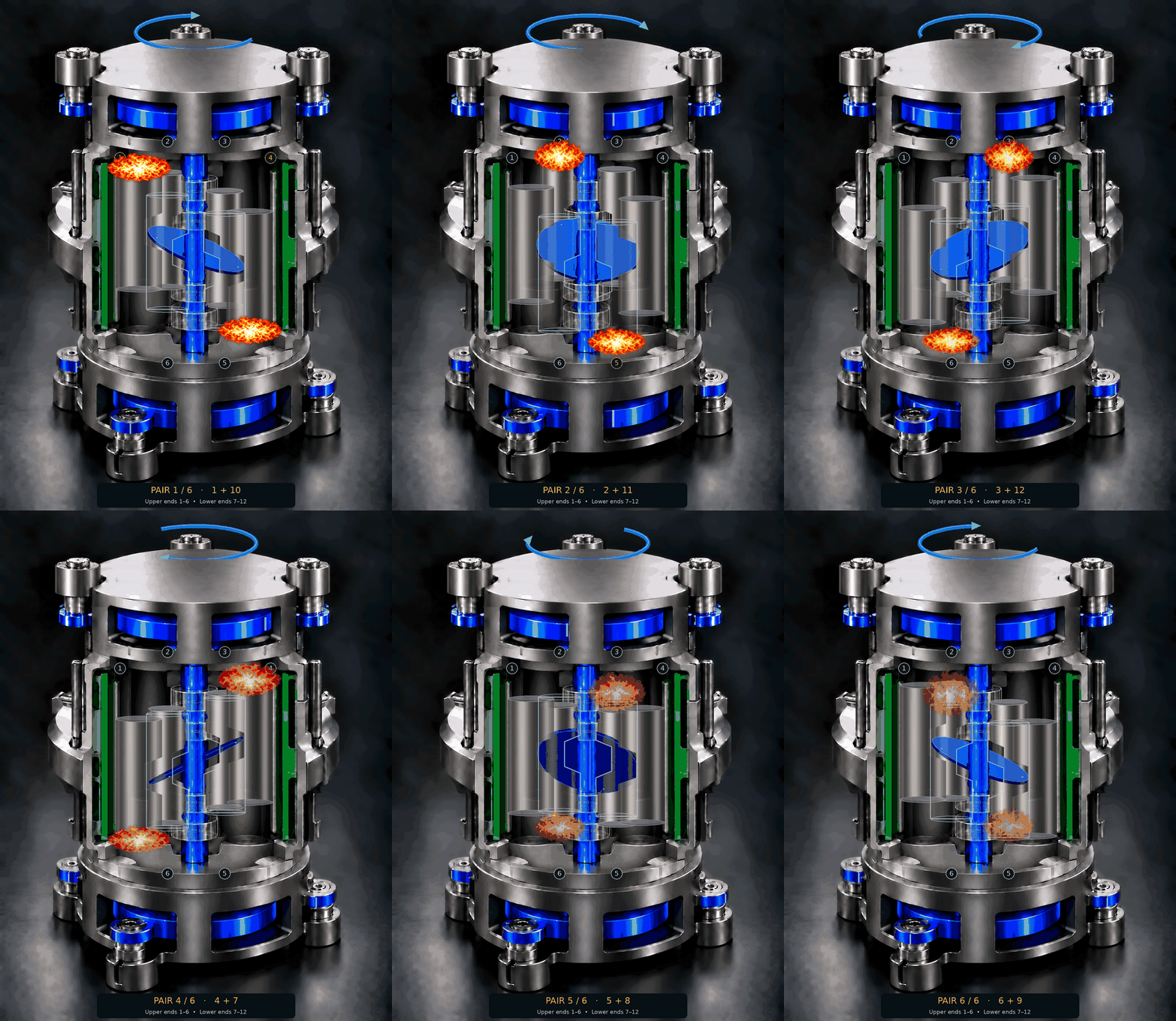
How combustion forces become rotation. Where heat travels. Where friction and auxiliary systems consume useful energy.
Rotodyne's axial double-barrel architecture, double-headed pistons, and 2-stroke, high-speed operation brings these questions into one integrated design, with the objective of maximizing the conversion of fuel energy into useful power from the smallest physical space, with the simplest structure.
Our solution represents the next-generation of performance-maxed, distributed power generation.
Power Dense Operation
~50 lbs
~12” x 7” x 7”
2 cylinder banks
6 common cylinders
6 double headed pistons
12 combustion events/ crankshaft revolution
~12 in3 displacement
2-cycle
~8,700 RPM
~50kW


THERMAL MANGEMENT
Aerogel & Ceramic barriers.
Force combustion heat to the exhaust not the walls.
H.A.L.O. provides additively manufactured engine component walls with engineered ceramic and graphene thermal gradient architecture, and with aerogel insulation positioned between wall matrixes the combustion heat is directed out the exhaust instead of into the walls. As such the Rotodyne engine has no external coolant system, and avoids the need for using and disposing of hazardous liquid coolant.
A combustion engine running without liquid coolant provides a significant climate advantage over the lifecycle on the product.
H.A.L.O. provides additively manufacturing magnetic components so that like polarity components repel each other. All pistons are magnetically engaged and sealed within a respective cylinder. The mid section of each piston transfer reciprocal motion to an angled thrust plate via magnetic forces, and to the crankshaft supported on magnetic bearings. Rotary valves are magnetically suspended The Rotodyne engines minimizes friction and avoids the need for Oil-based lubrication.
A combustion engine running without oil provides a significant climate advantage over the lifecycle on the engine.

CAD DESIGNED
Agile CAD design.
Digital-twin modelling.
H.A.L.O. is our proprietary additive manufacturing process for creating cermets with ceramics for thermal management, graphene for structural integrity, and ferrous materials for magnetic properties.
